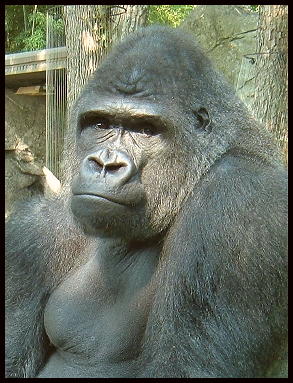
gentle and shy animals unless they are provoked or threatened. Adult males are known to beat their chest, run sideways, and tearing up vegetation as a show of dominance. It is interesting to note that gorillas can make up to 22 different vocalizations, each of which has its own meaning.
The western lowland gorillas live primarily in the equatorial rainforests of West Africa. The largest of all of the primates, adult males weigh between 350 to 600 lbs and can stand up to six feet tall. Females are the smaller of the species weighing between 150 to 300 lbs and standing up to five feet in height. The gorillas life span in the wild is 30 to 35 years, but in captivity, can live as long as 35 to 45 years.
While their diet in the wild consists of leaves, stems, bark, fruits and berries, Zoo's provide a more balanced diet of vegetables, fruits, cut branches and leaves, milk and yogurt, and vitamin supplements. While males can eat up to 70 lbs of food in a day, females usually eat around 20 to 25 lbs a day.
In the wild, a troop of gorillas is lead by one dominate silverback male. The troop usually contains one or two other, non-dominate silverback males, a number of adult females, adolescents, and infants. Just like other primates, gorillas don't make homes. Each evening before laying down to sleep, the gorillas collect leaves and tree branches and make a bed. This task is repeated daily as they wonder through the forest.
Even though the gorillas are the largest of all primates, they are